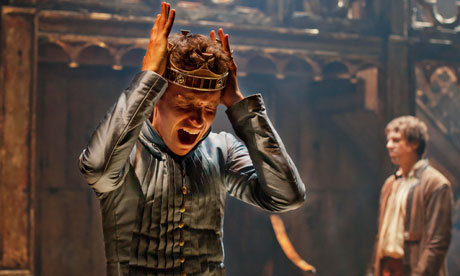
THE RECRUITING OFFICER - DONMAR WAREHOUSE

Stars - Tobias Menzies, Mackenzie Crook, Mark Gatiss, Rachael Stirling, Nicholas Burns, Nancy Carroll
Director - Josie Rourke
Memorable Quote - "Unless we could make ourselves some pleasure amidst the pain, no mortal man would be able to bear it."
Review - This showing of George Farquhar's excellent play ends tomorrow (14th April 2012) so I would suggest you've probably run out of time to go see it - and if you have not seen it, you have missed out. A thoroughly entertaining piece to start with, great use is made of the Donmar's layout in intricate choreography between each scene, placing the players around the stage, in the wings, and on small balconies on the second level. A group of five musicians accompany the play throughout with rousing choruses of 'Over the Hills and Far Away' along with other songs to capture the mood of particular scenes, each of them also taking turns to play all of the smaller parts in various different costumes and accents.
Mackenzie Crook, though playing a relatively small part for his star status, manages to conquer the stage completely during his scenes. As the gypsy fortune-teller he is hilarious, pitching his expression and tone perfectly to get the most laughs out of each line. Similarly laugh-a-minute is Mark Gatiss, virtually unrecognisable in heavily powdered and rouged face and long wig. Playing the French-hating Francophile Captain Brazen, m'dear, he captures the audience from his first appearance, throwing his hat at a member of the front row (in our case, a customer who was rather rudely reading his programme rather than watching the performance - to the joy of everyone else). In the end though you cannot help but root for the central character, Captain Plume, in his efforts to win the lady he loves - Sylvia.
Though the whole is filled with laughs, tricks, and musical gaiety, the ending holds a subtle twist. The comedy conclusion plays out as expected: the right men marry the right women, any misdemeanours are forgiven and forgotten, and the recruiting officers manage to recruit enough men to satisfy their superiors. All is well - but the band's final performance of 'Over the Hills and Far Away' sees one put down their instruments and march off to war after each verse. Finally only one remains, a lone voice now sounding very unsure of himself, and at last he too departs - a sloppy salute, a march that has no drum to beat time for it, and a sob at leaving home remind us that the subject of the play is the recruitment of untrained men to a life of glory that does not in actuality await them. The inherent tragedy of the situation then comes back to us: these men will die in battle or drown, or else come back disfigured or so forth - and the merriment they cause in the port is their only respite from a life of danger.
Laughter, sadness, good acting, good music, and audience interaction - the ingredients of a great play. From me, a resounding 5/5.


Mackenzie Crook, though playing a relatively small part for his star status, manages to conquer the stage completely during his scenes. As the gypsy fortune-teller he is hilarious, pitching his expression and tone perfectly to get the most laughs out of each line. Similarly laugh-a-minute is Mark Gatiss, virtually unrecognisable in heavily powdered and rouged face and long wig. Playing the French-hating Francophile Captain Brazen, m'dear, he captures the audience from his first appearance, throwing his hat at a member of the front row (in our case, a customer who was rather rudely reading his programme rather than watching the performance - to the joy of everyone else). In the end though you cannot help but root for the central character, Captain Plume, in his efforts to win the lady he loves - Sylvia.
Though the whole is filled with laughs, tricks, and musical gaiety, the ending holds a subtle twist. The comedy conclusion plays out as expected: the right men marry the right women, any misdemeanours are forgiven and forgotten, and the recruiting officers manage to recruit enough men to satisfy their superiors. All is well - but the band's final performance of 'Over the Hills and Far Away' sees one put down their instruments and march off to war after each verse. Finally only one remains, a lone voice now sounding very unsure of himself, and at last he too departs - a sloppy salute, a march that has no drum to beat time for it, and a sob at leaving home remind us that the subject of the play is the recruitment of untrained men to a life of glory that does not in actuality await them. The inherent tragedy of the situation then comes back to us: these men will die in battle or drown, or else come back disfigured or so forth - and the merriment they cause in the port is their only respite from a life of danger.
Laughter, sadness, good acting, good music, and audience interaction - the ingredients of a great play. From me, a resounding 5/5.